Who Should Own a GEO Program?
Nixal's view: marketing can lead a GEO program, but it should not have to deliver the work alone. When improving how a company appears in AI answers requires product facts, website changes, or customer evidence, the teams responsible for those areas need to participate. We recommend one person to run the program and a senior leader with authority over its budget and cross-team priorities.
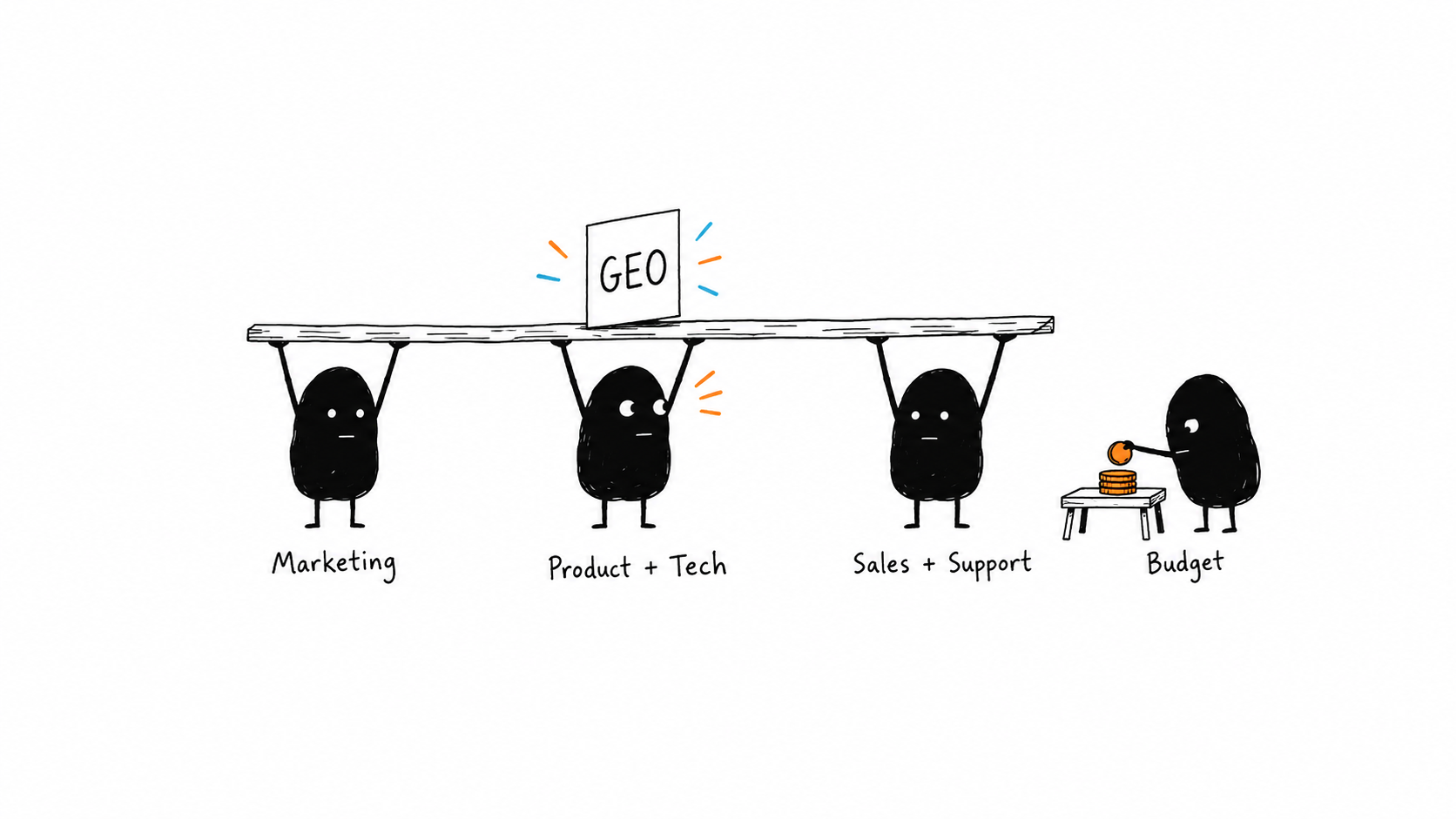
Assigning GEO to marketing is a reasonable starting point. Marketing looks after how the company presents itself and how customers discover it. But the work can reach beyond the pages marketing writes or the tools it buys.
Product capabilities need confirmation from people who understand the product. Technical changes need someone who can implement them. Questions from sales and customer conversations can help the team decide which answers deserve attention. A marketing owner can bring those contributions together; being accountable for the program should not mean having to supply all of them personally.
The question is therefore more specific than which department should own GEO: who runs the work, who contributes the necessary facts and changes, and who can decide what deserves the company's time and money?
Give the program an owner who can move work forward#
We recommend a named program owner, often in marketing, SEO, or product marketing. This person should understand the company's priorities, decide what to investigate, and keep an agreed action moving through to review.
That responsibility includes deciding whether an observation warrants action at all. An unexpected AI answer may reveal a factual problem, a missing explanation, or a question the company is not well suited to answer. It can also remain unexplained. The owner should be able to distinguish an observation from a supported recommendation before asking another team to spend time on it.
For each proposed change, the owner needs to explain the problem, the evidence, the decision required, and the person who can carry it out. "Improve our AI visibility" is too broad to be a useful request to a product or engineering team.
This role needs access to the people who hold the relevant facts and permission to bring blocked decisions to someone who can resolve them. Responsibility without that access leaves the owner accountable for work they cannot advance.
Bring in the teams the problem actually requires#
Marketing, product, technology, sales, customer support, and operations bring different information and authority. We would divide their responsibilities along those lines, while allowing people in smaller companies to cover more than one role.
| Team or role | Contribution to the program |
|---|---|
| Marketing, SEO, or product marketing | Choose the audience and questions to investigate, review how the company is presented, coordinate content and relevant external communications, and follow through on agreed actions. |
| Product or service experts | Confirm current capabilities, limitations, availability, and the evidence behind product claims. Identify when the answer reflects a real product limitation that messaging cannot fix. |
| Engineering or the website team | Investigate access and implementation issues, make necessary technical changes, and verify that intended information is available on the site. |
| Sales and customer success | Contribute actual customer questions, recurring misunderstandings, evaluation criteria, and feedback from conversations. Help assess whether the issue matters to customers. |
| Customer support | Bring recurring complaints and support requests, with enough context to distinguish a misunderstanding from an unresolved product or service problem. |
| Operations or service delivery | Check what happens during setup and delivery, where customers encounter friction, and whether the company can consistently deliver the experience its messaging promises. |
| Analytics or revenue operations, where available | Check what the company can measure about visits, inquiries, and sales activity, and keep those observations separate from changes in AI answers. |
Technical participation has a concrete purpose. Google's guidance for its generative AI search features says established SEO practices remain relevant and discusses crawling, indexing, and website implementation. Those are areas where the people responsible for the website may need to help. Google's guidance does not prescribe an organizational structure, and it does not mean every GEO task needs an engineering project.
The same distinction applies to the other teams. Product experts need to verify product facts; they do not need to attend every monitoring review. Sales should supply questions and feedback without having to interpret every dashboard. Bring in legal, security, or communications when a proposed claim or change requires their judgment.
Read public reviews alongside sales and support feedback#
Public reviews can describe both a valuable use case and the difficulty of making it work. In a G2 review reproduced on AWS Marketplace's Asana review page, dated September 25, 2026, Noah J. describes the value of tracking work across content, design, and approval. The same reviewer describes inconsistent team conventions that made projects disorganized. This is one reviewer's account, not a finding about all Asana customers.
For a SaaS team assessing its own feedback, that combination raises a useful question: is the strongest use case shared work with handoffs and approvals, and what support does a customer need to succeed with it? Answering it requires more than reading the public review. We recommend comparing the theme with sales conversations, support tickets, and onboarding or delivery records. We have not examined Asana's internal records; this is our proposed analysis, not a description of its process.
Sales can check whether the use case matters in buying decisions and whether its promises match the product. Support can identify where customers become stuck. Operations can check the setup and onboarding process. Product and engineering can assess whether the problem calls for clearer guidance, a configuration change, or a product fix. Technical work should follow that diagnosis, rather than being assigned automatically for every complaint.
Marketing can then decide which use cases deserve clearer public explanations and stronger evidence. A recurring need among relevant customers, supported by actual product capability and successful delivery, gives a better basis for that decision than the loudest review. Keep customer segment, product version, date, and source attached to the feedback; a review repeated on another site is not a second independent customer account.
For GEO, the output might be a use-case page, onboarding guidance, an accurate comparison, or a correction to an existing claim. Some findings should lead to service or product changes before new content. Review management should mean listening, responding, and resolving supported problems while preserving honest criticism. It should not mean making the visible reviews look better than the customer experience.
Make the handoff specific enough to act on#
For a product-description error, the first handoff should be to someone who can verify the disputed fact. The request should include the exact statement, the question that produced it, and the relevant answer record. Product can then confirm what is correct and where the authoritative information lives.
Once the fact is established, the program owner can determine what work is justified. If the company's own page is wrong, the person responsible for that page should correct it. If the fact is correct but difficult to find or understand, marketing and product can agree on a clearer explanation. Engineering becomes involved when implementation or access needs attention. If an external source contains an error, the appropriate team can request a correction without assuming it controls the publisher's response.
The owner should record what changed and arrange a later review of the relevant answers. A more accurate answer afterward is useful evidence to examine, but it does not by itself prove that the edit caused the change.
This is a proposed way to organize the work, not a claim that every answer problem follows the same sequence. Its purpose is to keep factual judgment, implementation, and follow-up connected. A table of department names is not enough if no one knows what they are expected to deliver.
Give budget and priority decisions to someone with authority#
A program owner may be able to recommend a change without being able to secure the resources it needs. When work competes with a product release, a website project, or other marketing investment, someone must decide whether it deserves priority.
We recommend a senior sponsor who can approve the GEO budget, agree on the business objective, and resolve conflicts between teams. In a small company, that may be the founder. Elsewhere, it may be a marketing leader or another executive whose authority covers the work. The title matters less than the decisions the person can make.
Where a company already has leadership responsible for its broader AI strategy and investment, GEO should connect to that direction. But a GEO program does not, by itself, require a new executive role or the transfer of every AI initiative to one person. The practical requirement is an identified decision-maker for this program's funding and priorities.
The budget should cover both ongoing monitoring and the people who review the findings, investigate content gaps, and carry out justified changes. That includes tools, allocated staff time or external support, and any content or technical implementation. A monitoring subscription alone does not fund the work needed to act on its findings.
The sponsor should also agree with the owner on what would justify continuing, changing, or stopping the work. That may include resolving important factual errors or improving representation in relevant answers. Where the objective is customer acquisition, visits and inquiries need their own evidence. A rise in the visibility score alone does not answer the investment question.
Keep the arrangement proportionate to the work#
Cross-team participation does not have to mean a large standing committee. For a limited investigation, the program owner may need access to one product expert and the person who manages the website. More extensive work may require planned capacity from several teams and regular decisions from the sponsor.
One person can hold several roles in a small company. What matters is that the responsibilities remain explicit: who verifies the facts, who makes the changes, and who decides whether further spending is warranted.
Sustained monitoring and content-gap review need an ongoing operating arrangement. We recommend using suitable tools to keep a consistent record of selected questions, answers, and available sources, with people assigned to review that record regularly. They need to compare what the answers say with current product facts and existing content, then judge whether the company needs a clearer explanation, additional evidence, a correction, or further investigation. An absence from an AI answer does not, on its own, establish that another article is needed.
If the internal team has the time and capability, it can carry out this work with tools and outside guidance where useful. If it cannot sustain that commitment, we recommend engaging external people or an agency to handle monitoring, analysis, and agreed follow-up. The company still needs to provide product and customer knowledge, approve priorities, and make budget decisions. Our guide to running AI visibility in-house or hiring an agency explains how to divide that work.
Before assigning the next GEO task, make sure the owner can reach the people needed to complete it and the leader who can resolve a resource decision. That is the support marketing needs if it is expected to carry the program forward.