Company Introduction#
Our client is a payment intelligence company founded in 2022, with under 50 employees and a presence in San Francisco and Singapore. Its AI models and analytics help ecommerce and SaaS businesses approve more legitimate payments and reduce fraud within their existing payment systems, allowing merchants to improve performance while keeping their current provider.
In early 2026, the marketing team noticed buyers turning to ChatGPT, Perplexity, and Google AI Overviews alongside traditional search to research solutions. The team wanted to test the waters, but was unsure what results to expect.
Challenge: Getting Considered Alongside Established Providers#
The company competes with established providers that have spent years building their brands and customer relationships. Many prospective customers already rely on platforms like Stripe. Switching can require new integrations, operational changes, and disruption to payments, making merchants reluctant to replace a working system.
The challenge was to earn a place on the buyer's shortlist and show why adding another tool was worth the cost and effort—even while keeping the existing payment provider.
Approach: Finding a Way into the Buying Conversation#
We began by looking at the decisions buyers were already making.
Where were merchants running into limitations with their current setup? What would prompt them to evaluate another solution?
Our algorithm generated more than 1,000 questions across industry-specific use cases and buying scenarios. We interviewed the sales and customer success teams and reviewed sales recordings to understand the concerns coming up in real customer conversations.
This research helped us narrow the list to 33 priority questions and gave the team a focused organic growth roadmap.
Looking Beyond the Dashboard#
We used the monitoring dashboard to track the company's AI visibility and citation performance. But tracking the numbers was only the starting point.
We examined the answers and cited sources behind competitors' appearances, looking for clues about what was earning them visibility and where the client's content fell short. Those findings helped us refine our content priorities as the program progressed.
Monitoring and competitive research remained connected throughout: changes in performance prompted investigation, and the findings informed what we worked on next.
Creating Room to Compete#
Our roadmap prioritized middle- and bottom-of-funnel topics. These reached merchants who were comparing approaches, evaluating products, and deciding whether an additional tool justified the investment—closer to a purchase than those researching payment problems for the first time.
This also gave the company a more focused way to compete with established providers. We invested heavily in long-tail topics and narrowly defined buying scenarios, including:
- Reducing false declines on Stripe.
- Managing chargebacks for AI subscription businesses.
- Comparing custom fraud models with Stripe Radar.
These were a few of the opportunities where the company could make its differences clear and explain how its products fit into a merchant's existing payment setup.
We combined new articles with updates to existing pages. New content expanded coverage of priority scenarios, while existing articles retained their substance and conversational tone, with clearer structure, relevant FAQs, and concise summaries making key answers easier to find.
Technical improvements supported the work, covering page speed, crawl and rendering checks, structured data, and overlapping pages. Broader educational content would follow once the priority buying scenarios were covered.
Results: An Exploratory Investment Delivers Measurable Gains#
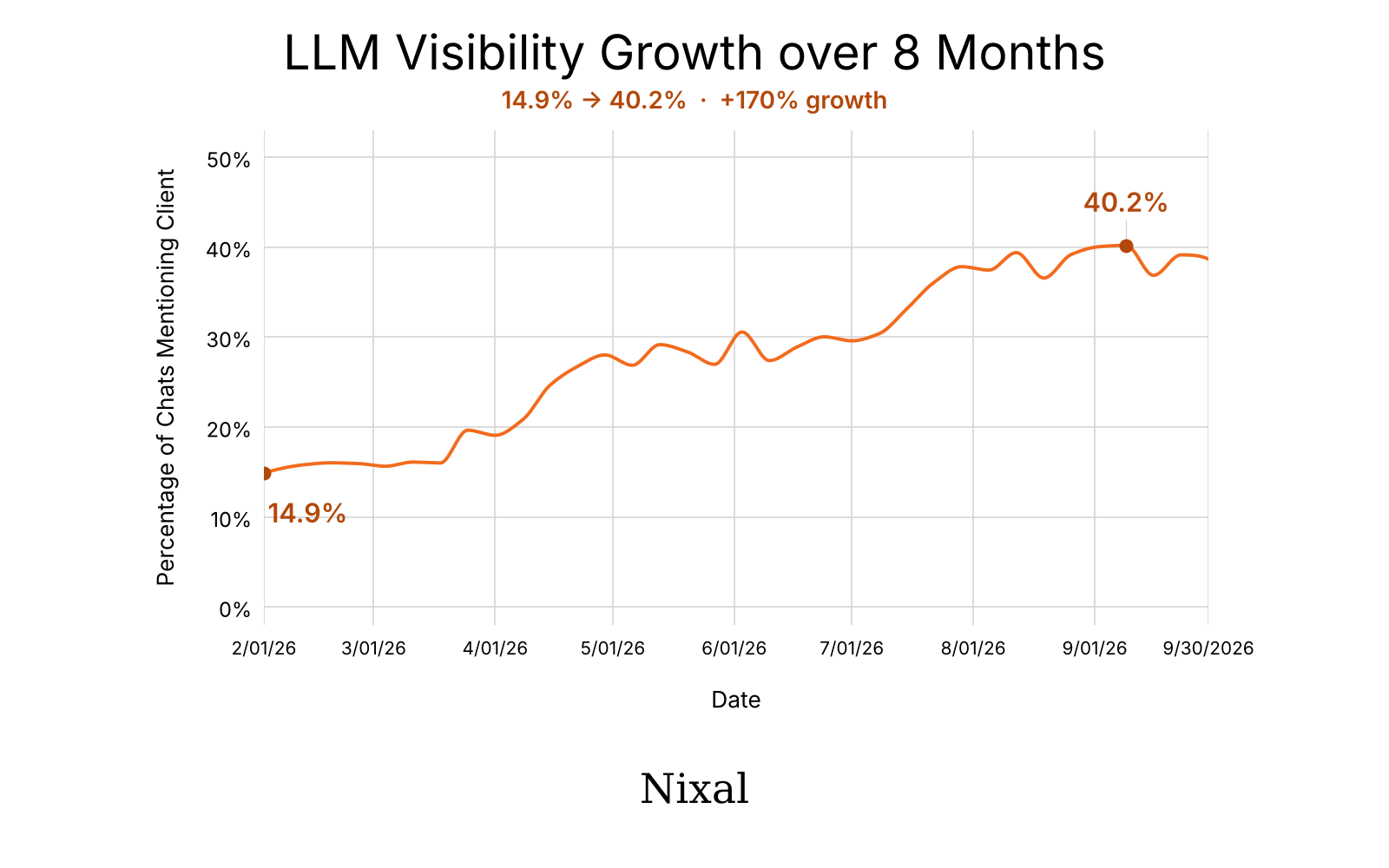
From February to September 2026, the company's AI visibility climbed from 14.9% to a peak of 40.2% across 33 tracked queries—an increase of 25.3 percentage points.
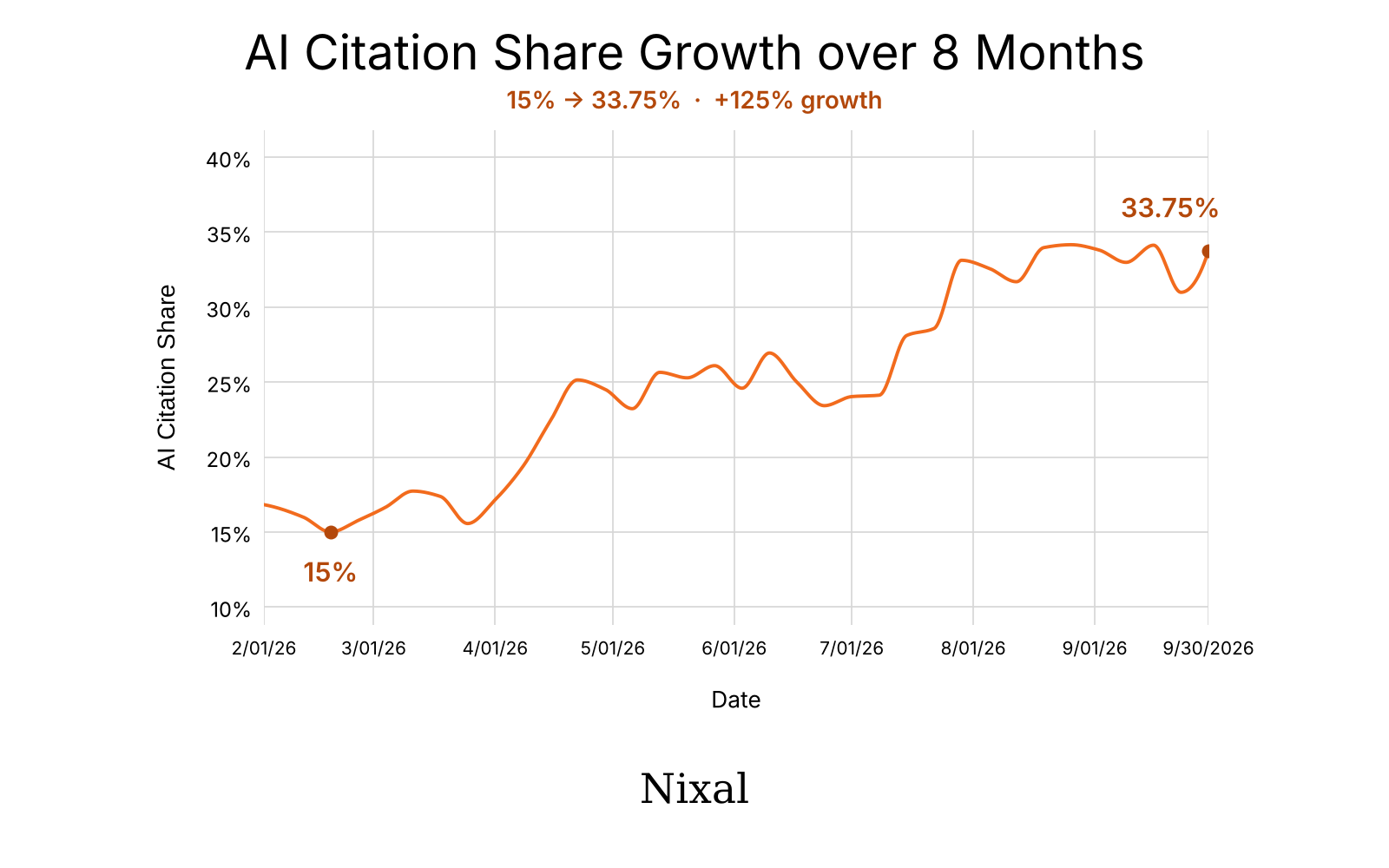
Over the same period, AI citation share grew from 15% to 33.75% across the same 33 tracked queries, a 125% relative increase.
What started as a test has given the company a clearer direction for AI search. The opportunity now is to build on that visibility, helping more merchants discover the company and understand what it can add to the payment systems they already use.
Q&A
Does good SEO mean we will show up in AI answers too?
A lot of the groundwork helps both: pages that are easy to access, useful content, and credible sources. But strong SEO does not automatically translate into AI visibility. You still need to check whether your company appears in relevant AI answers and how it is described.
Do we need to change how we write for AI?
The content should still sound like it was written for a person. In this project, we kept the substance and conversational tone of existing articles, then added clearer headings, summaries, and relevant FAQs to make the answers easier to find.
Is publishing more content enough?
Buyers need a reason to trust what they read. First-hand experience, clear explanations, and reliable facts give them something to assess. Publishing more pages cannot make up for missing expertise or evidence.
Should we focus on backlinks or brand mentions?
Look at both, but pay attention to the context. Where does the company appear, what does the source say about it, and is that source relevant to its buyers? Those details matter alongside the number of links.