Choose a GEO Provider That Will Do the Work You Need
Nixal's view: Look for a GEO provider that can explain its priorities, finish the agreed work, and show what changed afterward. We see AI search as part of a company's long-term brand credibility and digital assets. An article package or a one-time diagnosis can fit that plan. Before signing, establish who will direct the work and keep the information current after delivery.

A proposal can promise a diagnosis, content, and monthly reporting and still leave an important question unanswered: what happens between the report and the next decision?
Who checks whether an inaccurate product description needs a page update? Who gets the product team to confirm the facts? Who implements the change, and who checks it again?
Those handoffs are worth examining before you sign. A service list tells you what a company sells. A work sample and a clear division of responsibility help you judge whether it can deliver what you need.
Start with the decision your company needs to make#
Before comparing proposals, write down what the business needs and what your team already owns.
Perhaps the company does not know which buyer questions it should track. Perhaps it knows the missing information but needs help producing and publishing it. An experienced internal team may want an outside perspective on priorities rather than another writer.
Outside help can add capacity or a second view on a decision your team already knows how to make. Specify which you need before asking for proposals.
| What your company needs | What to look for | What to ask the provider to show |
|---|---|---|
| A clear starting point | Buyer research, a baseline, and priorities | Where did the questions come from, and why do they matter to this business? |
| A known content gap filled | Production with clear quality and delivery requirements | What will be ready to use, and who approves and publishes it? |
| Help with third-party information | Relevant source review and a defined approach to follow-up | Which sources need attention, and what will you actually do about them? |
| Ongoing ownership across teams | A review schedule and people responsible for action | How does a finding become an approved change and a later check? |
A provider does not have to cover every row. Someone does need to own the work outside its scope.
Follow the work from diagnosis through review#
We would examine how the provider handles the work over time. Research, implementation, and review each need an owner, whether that owner sits inside the company or with a partner.
Decide what deserves attention#
Ask how the provider builds its question list. Customer conversations, sales objections, support requests, product information, and relevant search data can contribute different parts of the picture. AI-generated questions can help explore ideas, but they need to be checked against what buyers actually need to know.
The provider should connect those questions to your products, markets, and the people involved in a buying decision. It should also examine existing company information, relevant third-party descriptions, and competitor coverage before prescribing new material.
We want to see the reasoning behind a priority. "Your competitor appears here" starts an investigation; it does not, by itself, explain what your company should publish.
Complete the agreed work#
Once the gap is clear, ask what the provider will change and where its responsibility ends.
A clearer pricing explanation, an integration document, a customer story, and a request to correct a third-party description involve different work. Writing a draft, getting it approved, publishing it, and following up with an outside publisher also need different access and coordination.
For third-party work, clarify whether the engagement includes identifying opportunities, preparing material, contacting the source, or following up. The provider can commit to agreed outreach work; the publisher retains its own editorial decision.
These details matter more than whether a proposal calls the service "full execution."
Review what changed and decide what comes next#
The information your company publishes needs care after delivery. A pricing change can leave an older comparison out of date. A product update can make an integration guide incomplete. Third-party coverage, competitors, and AI answers can change too.
For ongoing service, ask what the provider checks again, how it investigates a change, and who implements the response. Checking, reporting, and updating can follow different schedules. A changed answer may call for another observation before it calls for a rewrite.
For a one-time project, ask who receives the work, the records, and the next review responsibility. Long-term maintenance does not require keeping the same agency forever. It requires the company to retain ownership of its information and know who will care for it next.
Ask the provider to show how it makes decisions#
We would ask for an actual work sample and have the provider walk through a recommendation. An anonymized example is useful if it preserves enough detail to assess the work.
| Ask to see | What it helps you judge |
|---|---|
| A question set with its sources and selection rationale | Whether the team understands a buying decision or has produced a list of plausible prompts |
| A recommendation tied to a specific gap | Why the proposed change deserves time and money |
| The completed work behind that recommendation | Whether the team can deliver at the required quality and explain what the customer supplied |
| A later review and the resulting action | Whether the team investigates findings and adjusts the work |
Ask the provider to explain a recommendation it chose not to pursue, too. A team should be able to say why another article, a particular placement, or a page rewrite was not worth doing.
A useful walkthrough should make the recommendation understandable enough for your team to approve, question, or reject it.
When an article package is the right purchase#
An article package can be a sensible purchase. A team with a clear plan, reliable product facts, and an editor may need exactly that production capacity.
In that arrangement, the provider should be accountable for the agreed quality and delivery. The company, or another partner, still owns the decisions about what to commission, how to use it, and when to revisit it. An article quota alone does not establish responsibility for AI recommendations or business results.
A diagnosis-only engagement can work on the same principle. A useful plan has value when someone has the access, time, and authority to act on it.
For a managed engagement, we would expect the proposal to go further and assign continuing responsibility for those decisions. The difference is the work being purchased, not whether the contract contains an article count.
For specific prices and a closer look at how to compare the work included in different quotes, see how much GEO services cost and how to compare the budget.
Agree how the work will be evaluated#
A capable team should be willing to define how its work will be checked. We would review 3 dimensions: whether the agreed work was completed, how AI describes and recommends the company, and what reaches the business.
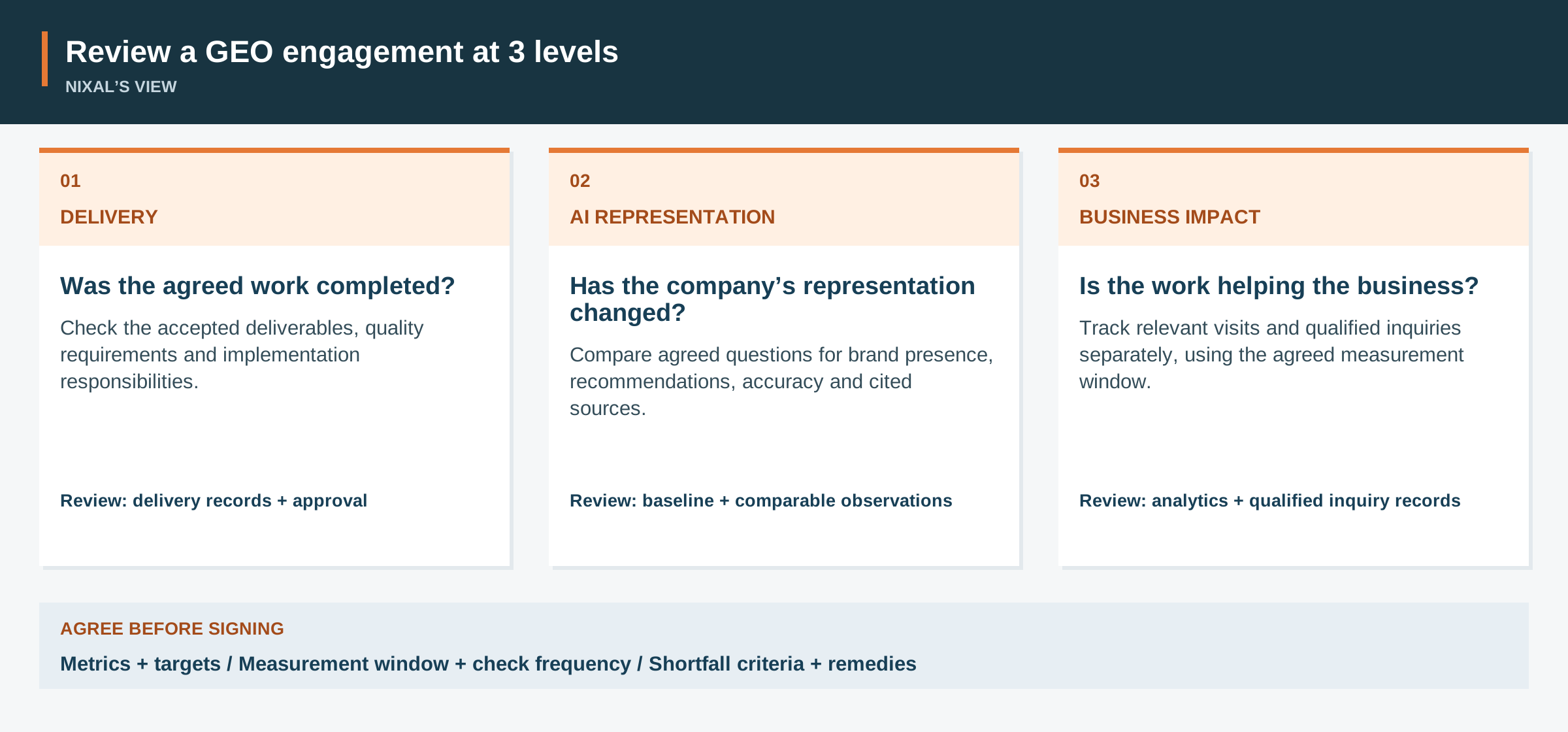
Before signing, translate those dimensions into agreements the company can check.
| Agreement | What needs to be clear |
|---|---|
| Deliverables and ownership | What gets completed, what quality is expected, what your team supplies, and who approves and implements changes |
| Metrics and targets | Which questions, platforms, markets, baseline, and measures support the review; how AI representation and business outcomes are reported separately |
| Timing | The measurement window, checking and reporting frequency, and the date for evaluating progress |
| Shortfalls and follow-up | What counts as a missed standard, how remedial work and rechecks are handled, and what happens if the agreed standard remains unmet |
Ask to see the underlying answers and source records alongside the summary. Brand presence, recommendation, and description accuracy answer different questions. Visits, trials, and qualified inquiries need their own measures. A combined score should not hide the distinction you need to make.
There is also a difference between agreeing a target and guaranteeing an AI platform's response. A provider can commit to deliverables and agree a remedy for a missed standard without claiming control over an external system. Have it explain what it promises and what triggers the remedy. For more on that distinction, see what a GEO provider can and cannot promise.
Choose the team you can hold accountable#
By the end of the comparison, you should be able to trace an important buyer question through the provider's reasoning, the work it will complete, and the way that work will be reviewed.
A smaller production partner can be the right choice when your company already owns the rest. A broader engagement should explain who takes on the additional responsibility and demonstrate the ability to do it.
We treat AI search as ongoing care for information buyers rely on. Choose a provider whose work fits that plan, with clear responsibilities during the engagement and a usable handover afterward.
FAQ
Does a GEO provider need to do everything?
No. It needs to complete the work it is hired to do and make the remaining responsibilities clear. Your team or another partner can own the rest, including ongoing maintenance.
Is a diagnosis-only engagement enough?
It can be when someone has the access, skills, time, and authority to act on the plan. Confirm the handover and who will implement and review the recommendations.
Can a fixed article package be a good choice?
Yes, when the company knows what it needs and has people to direct, approve, publish, and maintain the content. Agree quality and delivery requirements; an article count alone does not establish responsibility for AI recommendations.
What work samples should we ask for?
Ask for a question set with its rationale, a recommendation tied to a gap, the completed work, and a later review. Have the provider explain its own contribution and the customer’s responsibilities.
Can a provider agree targets and remedies without guaranteeing AI rankings?
Yes. A contract can define targets, a measurement window, missed standards, and remedies. That does not give the provider control over an AI platform’s future answers.