How Much Do GEO Services Cost in 2026?
Nixal's view: we see AI search as part of a company's long-term credibility and digital assets. Article packages and fixed-deliverable services can both have a useful place in that work. The bigger decision is how the company will keep its own information current, check third-party descriptions and competitors, and review progress over time. Among the public offers discussed here, monthly fees range from $3,400 to enterprise plans starting at $10,000+. Compare the responsibilities those fees buy within that longer-term plan.
What are agencies charging?#
Percepture lists Enterprise starting at $10,000+ per month, Authority at $8,500, Growth at $6,000, and Launch at $3,500. OutreachBloom lists Gold at $4,900 per month and Silver at $3,400. These public prices were checked on October 25, 2026.
That is a substantial spread. We would not read it as a price ladder where the higher tier is automatically the better purchase. The question is how much work the company needs to buy, and whether the proposal actually includes it.
Percepture describes Enterprise as custom scope. A buyer still needs to see which products, markets, research, production, or implementation requirements account for the fee. "Enterprise" alone does not explain the additional spending.
At any of these price points, a proposal should make it possible to understand what will be completed, who will complete it, and what remains with the company.
Content volume explains part of the price#
OutreachBloom lists 15 pillar content pieces per month in Gold and 10 in Silver, alongside other services. That is a concrete difference a buyer can assess, though it does not explain the entire price difference.
If a team has already identified the missing pages, gathered the product facts, and assigned an editor, buying production capacity can make sense. If 10 pieces cover the requirement, a smaller package may be sufficient.
The important detail is where delivery ends. A brief, a draft, an approved page, and a published page leave different amounts of work with the buyer. Revisions, fact-checking, design, and publishing need to be assigned somewhere.
There is nothing wrong with pricing a defined amount of content. But a production commitment does not, on its own, assign responsibility for deciding whether those pieces are the work the company needs.
What else is a managed GEO fee paying for?#
This is where we expect a managed engagement to explain its value.
Before committing production time, someone needs to establish which buyer questions matter, check what the company already answers, and decide which gaps deserve attention. One method we use is a buyer question map.
That check also extends beyond the company website. Relevant third-party pages may describe the business accurately, omit important facts, or repeat outdated information. Competitor content and the sources appearing beside it can reveal unanswered buyer questions or evidence worth investigating. The task is to decide which gap matters, not to copy every competitor page or pursue every mention.
For a brief example, consider a HubSpot-based sales team evaluating Apollo. The user needs workflow information, RevOps needs integration details, and the budget owner needs the full commitment. Apollo distinguishes two-way CRM sync from enrichment-only access, so a generic claim that it "integrates with HubSpot" does not answer every participant's question. Apollo integration documentation.
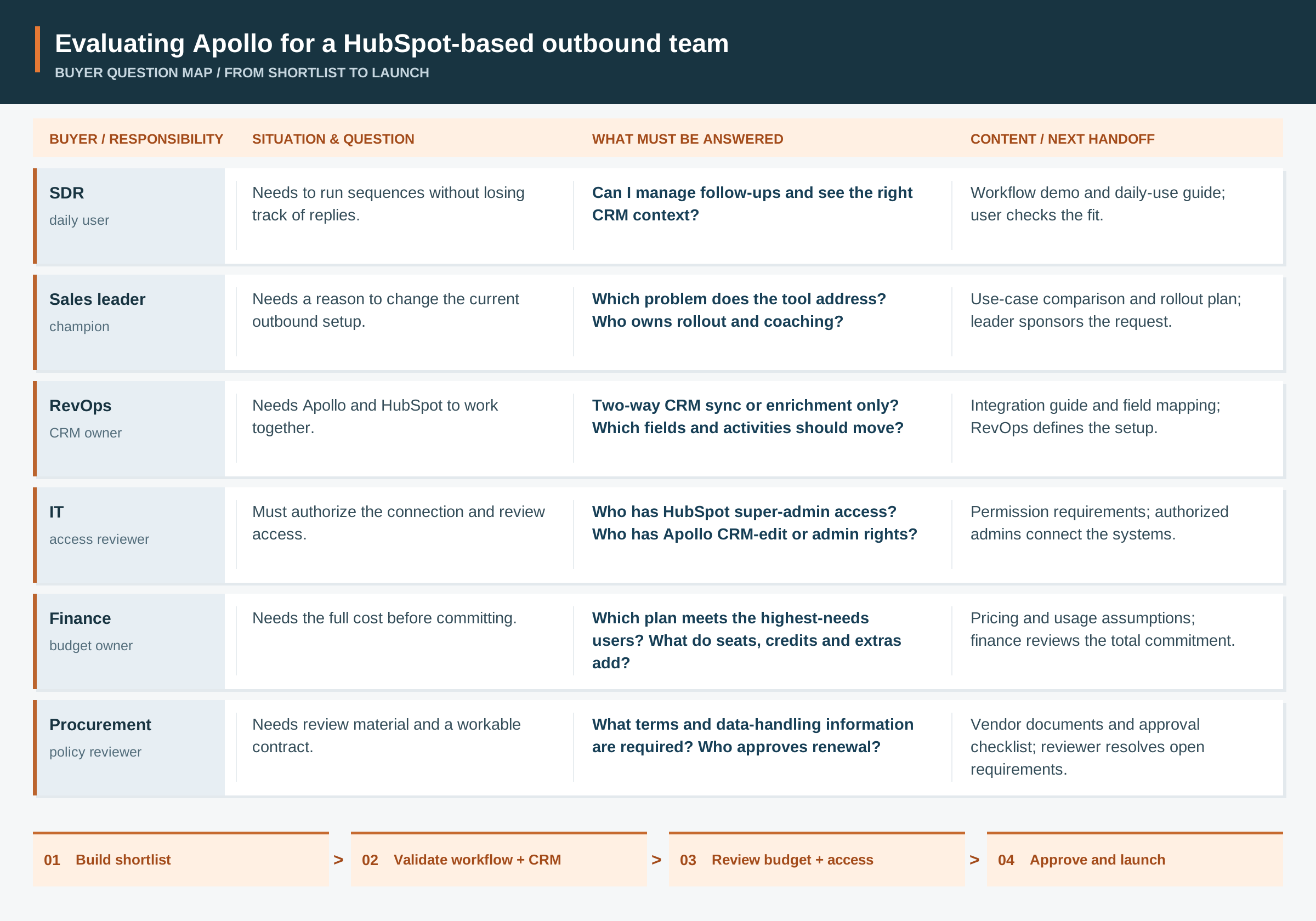
The pricing implication is direct: finding those gaps and choosing a useful response is work before the writing begins. The response might be a clearer pricing page, an integration guide, or better-organized approval material. It need not be another blog post.
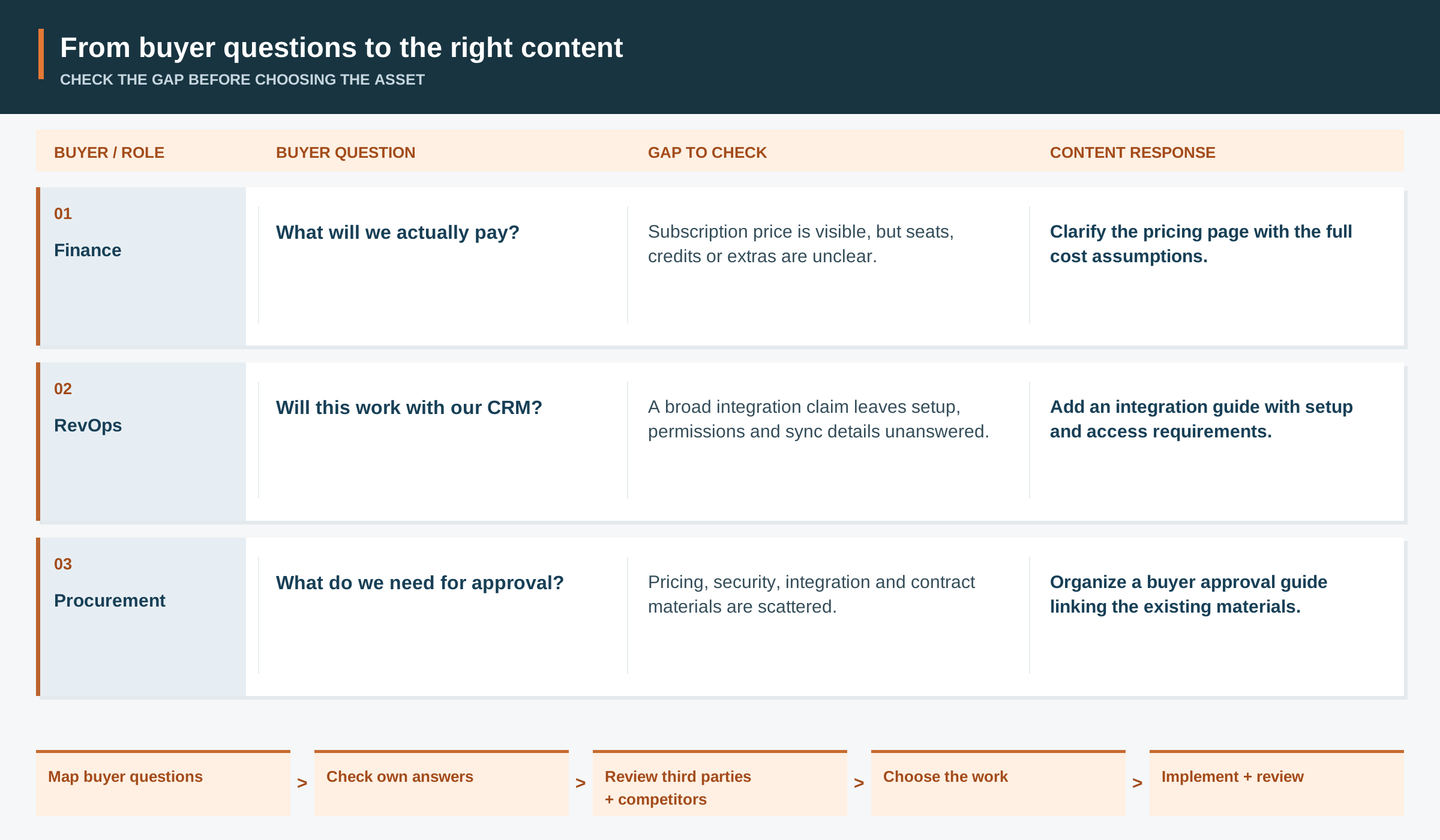
The proposal should assign the decisions, implementation, and review. Those responsibilities can sit inside an article package, remain with the internal team, or be divided between partners. The buying format matters less than whether the arrangement fits a long-term plan and leaves the necessary work with someone able to complete it.
What the recurring fee should keep working on#
The question map explains how the work begins. A recurring fee also needs to explain what continues.
Our view is that a company's product information, documentation, customer evidence, and public reputation are assets worth maintaining. A single AI answer is an observation of how the company is being represented at that moment. It is not the asset itself.
For a SaaS business, that distinction matters. Pricing changes. An integration gains new capabilities. A security document is updated. An older comparison may still describe a feature the product has replaced. Public sources, competitors, and AI systems can change too.
A one-time review can identify those issues today. Ongoing service should assign responsibility for checking what matters again and acting on what has changed.
For example, an ongoing engagement could divide the work as follows.
| Role / responsibility | Part of the service | What the proposal should specify | What the buyer can review |
|---|---|---|---|
| Marketing + Sales / buyer context | Question list | Inputs from customer and sales conversations, support, product information, and search data; priorities checked against business needs, competitors, and third-party sources. AI suggestions support research rather than establish demand. | An agreed question set tied to buying decisions, with clear product, market, and platform coverage. |
| GEO analyst / evidence and comparison | Measurement | A baseline and comparable checks of brand presence, relevant recommendations, description accuracy, and visible sources. Retain the question, date, platform, and available settings; repeat observations where needed. | Recorded answers and changes against the baseline. Visits and qualified inquiries are measured separately. |
| Project owner / monitoring schedule | Checking cadence | Routine frequency, repeat checks, and triggers for additional review, such as a major product update or an important factual error. | A checking schedule and a process for investigating material changes before deciding on updates. |
| Service lead + internal owner / decisions and action | Reporting and follow-up | Reporting frequency, completed work, interpretation of changes, next actions, and owners. A monthly review is one possible arrangement; important errors need a route for earlier attention. | A report that supports decisions, an action record, and responsibility for follow-through. |
Checking, reporting, and content updates run on different schedules. More frequent checks do not require more reports, and a single changed answer does not automatically justify a rewrite.
These details make two monthly fees meaningfully comparable. A short question list checked on one platform is a different scope from a broader set across products, markets, and platforms. Internal product and technical owners still need to confirm business facts.
Some months may call for new material. Others may be better spent updating an existing page, correcting a description, strengthening evidence, or resolving a handoff. The work should follow the need rather than a requirement to produce something new every time an invoice is issued.
The retainer should define the review scope, included implementation, and work requiring a separate agreement. That makes ongoing maintenance a service the buyer can assess, rather than an open-ended promise to keep improving visibility.
Maintaining that base is not a reason to chase every fluctuation or keep increasing spend. Regular reviews should help decide what to continue, change, or stop.
The monthly fee is not always the full budget#
Percepture lists link and mention building separately. Growth's $6,000 starting fee plus its corresponding $1,200 add-on totals $7,200 per month. Digital PR starts at $4,500 per month.
An add-on belongs in the budget when the project needs that work and its scope is clear. It should not be purchased simply to make a package look complete.
We want a quote to show both the agency's responsibilities and the tasks it leaves elsewhere. Otherwise, a lower monthly fee may simply move spending and coordination back inside the company.
How we would compare GEO quotes#
We would ask the provider to explain both the first round of work and the recurring responsibility.
Which problem will it investigate first? What will be completed within the fee? What will it review regularly, who implements the updates, and which approvals remain with the company? The proposal should make the ongoing service as concrete as the initial deliverables.
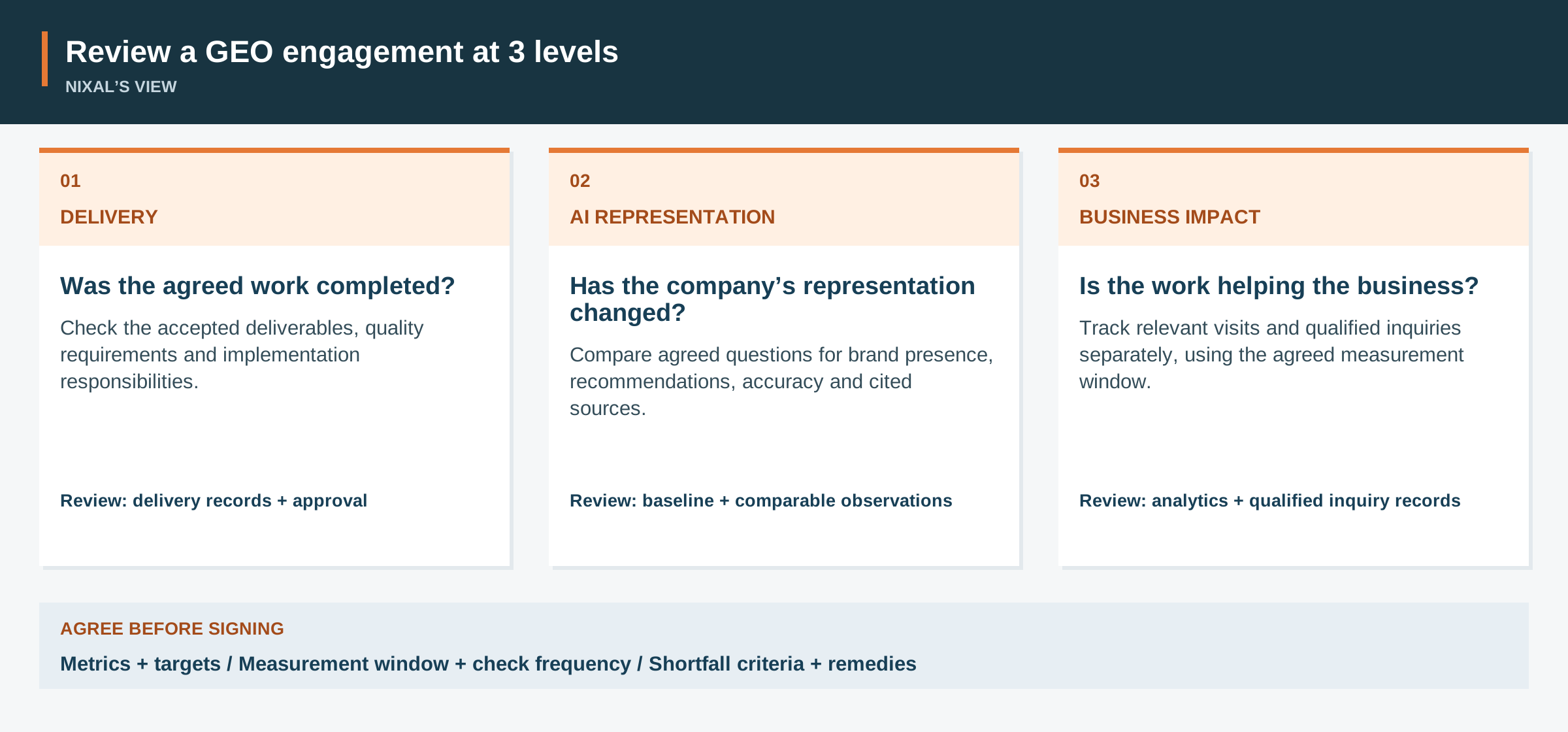
We would review the engagement at 3 levels: delivery, AI representation, and business impact. Each level has its own evidence and its own owner.
Then we would examine actual work to assess whether the team can deliver to the required standard.
Before signing, we would agree the acceptance terms in writing. A compact version:
| Before signing | Agree in writing |
|---|---|
| Acceptance metrics | Agreed deliverable quality and, where applicable, AI metrics such as brand presence and recommendations across the agreed questions. Set target, baseline, denominator, and platform coverage. Being indexed alone does not establish recommendation or business impact. |
| Measurement window and checks | The period that counts toward acceptance; the frequency of checking, data reconciliation, and reporting; the review date; comparable conditions. |
| Shortfall and remedial work | What counts as a missed standard; how disputed or missing data is handled; whether remedial work is included; its scope, deadline, and recheck. |
| If the standard remains unmet | A contractually agreed response. Examples include further correction, service credit, adjustment, or exit, along with the relevant conditions. |
A higher-priced proposal needs to explain its additional scope. A smaller production package can suit a team that already owns the strategy and maintenance. Neither earns its value from the number on the invoice alone.
We do not expect a provider to control an outside AI platform. We do expect it to explain its recommendations, complete agreed work, and use review findings to guide the next investment.
For the buyer, that makes the monthly decision clearer. The company is funding both useful work now and the continued care of information buyers rely on, not simply another report or another batch of articles.
These public prices are examples, not a market average. For more on assessing delivery capability, see how to choose a GEO provider.
FAQ
What do GEO services cost per month?
Public examples checked on October 25, 2026 include Percepture tiers starting at $10,000+, $8,500, $6,000, and $3,500 per month, and OutreachBloom plans at $4,900 and $3,400. Scope, implementation, and separately priced work affect the comparison.
What should a recurring GEO fee cover?
Alongside agreed production and implementation, it should define regular checks, investigation of important changes, updates to relevant assets, and recommendations about what to continue, adjust, or stop.
Does each question need a new article?
No. An existing page, integration document, pricing explanation, or other asset may already be the right place for the answer. First check the existing coverage.
When is an article package enough?
When the company understands the required work and has people to direct, approve, and use it. Confirm quality, delivery scope, and publishing responsibilities.
Does managed GEO guarantee results?
No. We expect accountability for diagnosis, agreed execution, and review. AI representation, traffic, and inquiries need to be evaluated separately, and an outside platform's response cannot be guaranteed.