AI Visibility Measurement: Your Score Went Up. What Actually Improved?
Nixal's view: an overall AI visibility score is not enough to judge whether the work is helping your company. First check what it measures and what changed in the answers that matter to your business. A higher score alone does not prove better answers, more customer exposure, or more visits and inquiries.
An AI visibility score summarizes a brand's presence within a tool's data. The result depends on the questions, platforms and calculation behind it. It can help you follow a defined set of questions over time, but it cannot replace checking how the company is described or measuring the business response.

The report says AI visibility increased this month. That sounds encouraging, until someone asks the obvious question: what changed for the company?
The answer is often unclear. A company can be mentioned more often while still being described incorrectly. Its website can earn more citations while a competitor receives the recommendation. A single score can rise even though the result the team cares about has not moved.
What is an AI visibility score?#
AI visibility platforms do not all put the same inputs behind their headline number. That does not make the scores invalid. It does mean that 2 scores with the same 0–100 scale may be answering different questions.
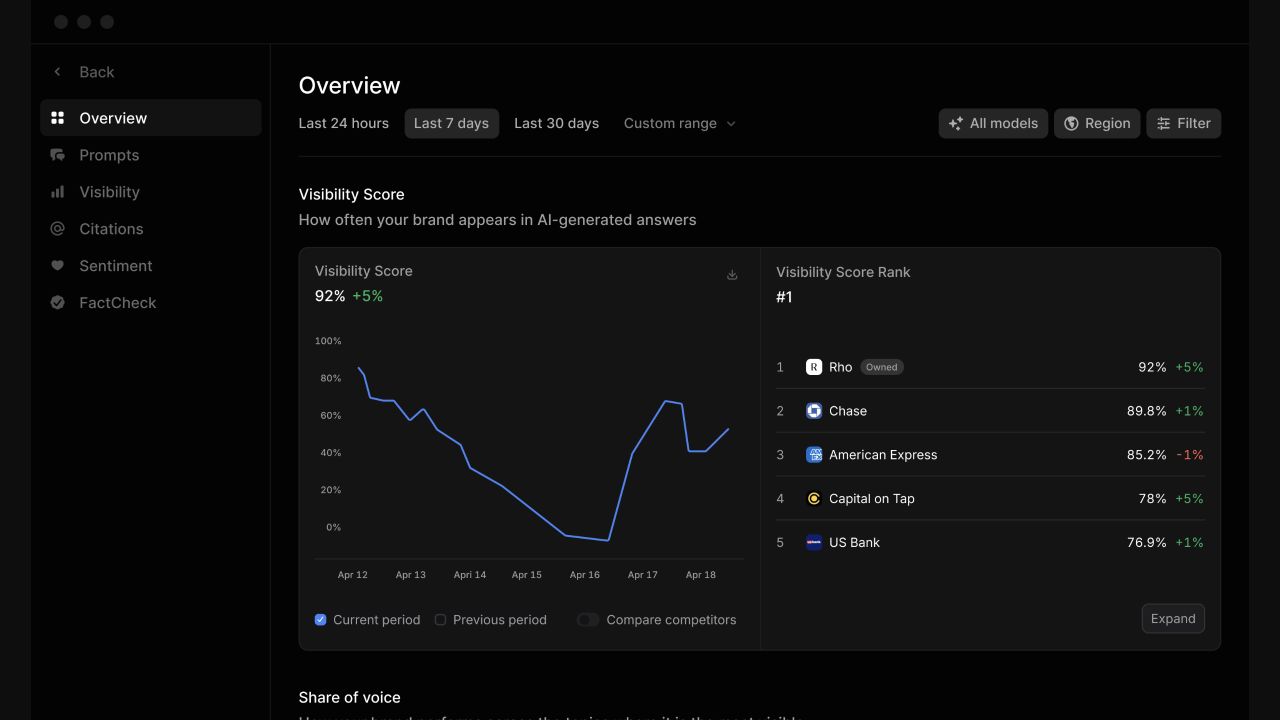
Profound's official metric definition describes Visibility Score as the share of tracked responses in which the brand appears, using responses that contain at least one brand as the denominator. The same product treats Share of Voice as a separate competitive measure based on the brand's mentions relative to all brand mentions.
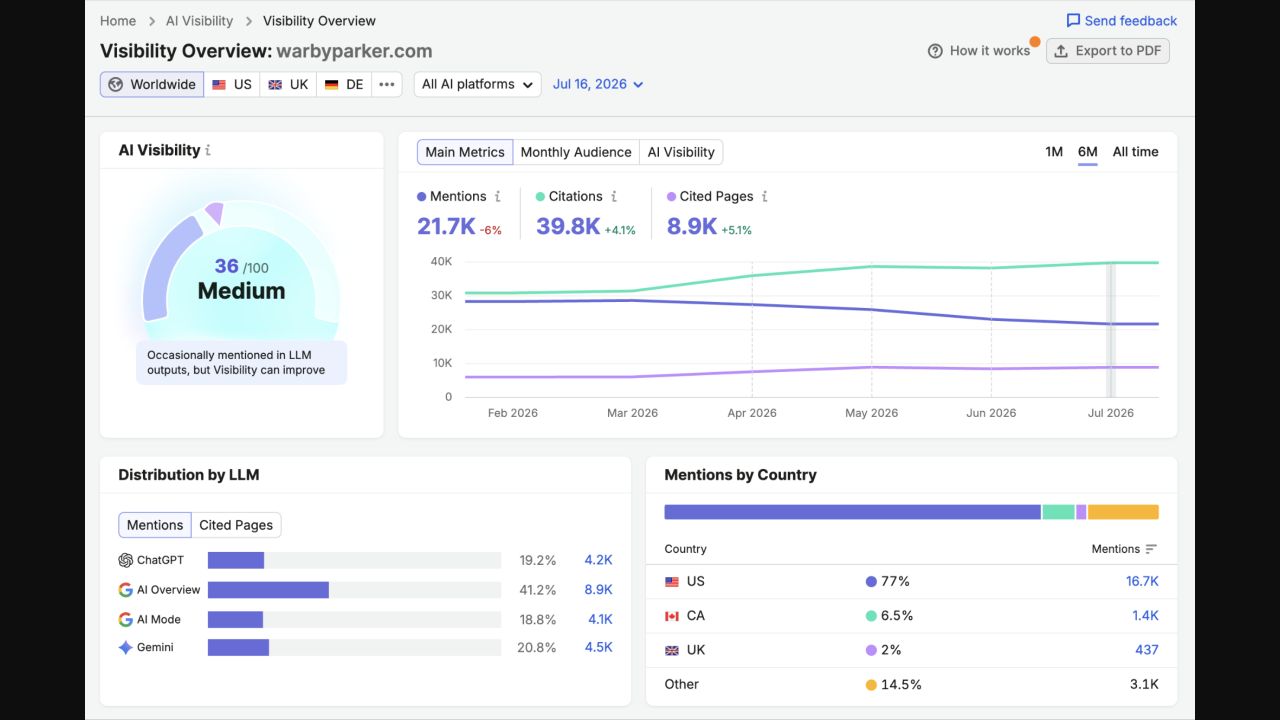
Semrush uses another construction. Its methodology page says AI Visibility combines topic coverage with mention consistency. The dashboard then reports mentions, citations, cited pages, and distribution by platform separately.
Otterly provides a third example. Its brand-report guidance separates brand coverage, Share of Voice, mentions, and citations, and advises readers to open the underlying prompt when a number looks unusual.
These tools are doing a useful job: turning repeated AI answers into something a team can monitor. The problem begins when a report presents the score without the tracked prompt set, platforms, denominator, competitors, or answers behind it. A 10-point change in Profound and a 10-point change in Semrush do not necessarily describe the same event.
Compare the definitions before comparing the scores#
The official definitions above describe different measurements. The last column below is our guidance on how to interpret them.
| Tool and measure | What the number summarizes | What to check before comparing |
|---|---|---|
| Profound Visibility Score | Responses containing your brand as a share of responses containing at least one brand. | Which prompts and engines were tracked, and which responses enter the denominator. Keep Share of Voice separate. |
| Semrush AI Visibility | A 0–100 score combining topic coverage and mention consistency. | Which report, regional database and platform view you are comparing. Do not read the score as a simple percentage of answers mentioning you. |
| Otterly brand coverage / visibility | How often a brand is named across the report's prompts. | Which prompts, competitors and brand-name variations the report includes. Read mentions and citations separately. |
None of these measures, on its own, establishes that a company was accurately recommended or gained customers.
What is a good AI visibility score?#
A score is useful when it helps you understand a change that matters to your company. There is no single passing grade across the tools above, and even a higher score in the same tool is not automatically progress.
A score can be calculated correctly without representing what your customers actually see. For a tool that runs selected prompts, an accurate mention count describes the answers it collected. It does not establish how often customers ask those questions, how often they receive the same answers, or whether the company was described correctly.
Choosing the questions is therefore part of the measurement judgment. A set drawn from customer conversations may help investigate a recurring concern. A set of category questions may help explore where competitors appear. Both can be useful, but neither should be presented as a complete picture of customer exposure. The score needs to stay attached to the question set it describes.
Use the same tool and a consistent set of questions and platforms to follow a trend. Compare relevant competitors within that same scope. If the setup changes, separate that change from the trend rather than treating the new number as a direct improvement over the old one.
Then read the answers that changed. For product selection, is the company being considered for needs it can actually meet? For product understanding or support, are important capabilities and limitations described correctly? A rising average does not resolve a consequential error or an absence from those questions.
A rising score alone is not a reason to increase the budget. Improvements in relevant answers can justify continuing the work, even before a revenue effect is visible. But visits and inquiries still need their own evidence, and an improved answer does not by itself prove that your edits caused it. Set the business goal first, then decide whether the score helps you judge it.
Start with what the company needs to understand#
Most teams are trying to understand one or both of these outcomes:
AI Brand Influence: Is the company appearing in relevant answers, being represented accurately, and receiving the right role when people ask about a problem, category, product, or provider?
Business Contribution: Is that influence contributing to something the company can observe, such as AI referral traffic, branded demand, qualified leads, pipeline movement, fewer support problems, or another defined result?
The first can move before the second. That does not make it unimportant. It does mean that more mentions are not automatic proof of revenue, pipeline, or customer impact.
The same answer can produce 3 different signals#
The same AI answer can name your company, cite your product documentation, and recommend a competitor. That is why mentions, citations, and recommendations need to be measured separately.
All 3 measurements are valid. They simply answer different questions:
- Mention: Did the company appear?
- Citation: Which visible source supported the answer?
- Recommendation: What option did the answer present for the stated need?
There is one more question a count cannot answer: How was the company represented? A mention may repeat outdated pricing, miss an important use case, or confuse one product with another. That can matter more than whether the count moved from 12 to 18.
What this changes for SaaS and consumer companies#
For a SaaS company, a frequently cited documentation page can be genuinely useful. It shows that the page is helping explain a feature or integration. But if the company remains absent from comparison and provider-selection answers, producing more documentation just to increase citation count may be the wrong next investment. The gap may be positioning, comparison evidence, customer proof, or third-party support.
For a consumer company, growing mentions can hide a different problem. AI answers may repeat an old specification, recommend the product for the wrong household, or rely on retailer and review pages the brand has not checked. Publishing more content will not correct those answers if the underlying facts remain inconsistent across the sources people and AI systems encounter.
The useful question is not "Which metric is best?" It is "Which decision would we make differently if this metric changed?"
Choose the measure from the decision#
Use the business question to decide what belongs in the report:
- Do people encounter us in relevant AI answers? Track presence across the questions and platforms that matter to the company.
- Are we described correctly? Review the answer itself, the errors or omissions, and the sources supporting the description.
- Do we enter comparisons and recommendations? Track the role the company receives, who appears instead, and the situations where that changes.
- Which pages and external sources shape the answer? Inspect citations, source types, and answer context rather than counting domains alone.
- Is the work contributing to growth or another business result? Compare answer-level changes with referral traffic, branded demand, leads, pipeline, support demand, or another observable signal. Keep the limits of attribution clear.
This approach does not require every company to optimize for a purchase. A support team may care about incorrect instructions. A communications team may care about reputation. A growth team may care about discovery and demand. The measurement should follow the outcome, not force every use case into the same score.
Let each platform metric answer the question it is built for#
Bing Webmaster Tools defines total citations as sources displayed in AI-generated answers. Microsoft also explains that its aggregated cited-page metric does not show ranking, authority, placement, or the role a page played in an individual answer.
Google's generative AI performance report counts impressions when links to a site appear in supported generative AI Search features. That gives a company useful first-party performance data. It does not show whether the company was recommended, described correctly, or connected to a later business result.
These metrics are not weak because they are narrow. They become misleading only when a report asks them to prove something they were not designed to measure.
Ask these questions before accepting the report#
Whether the report comes from an internal team, a dashboard, or a service provider, ask:
- What exactly counts as a mention and a recommendation?
- Are brand presence and domain citations reported separately?
- Can we inspect the underlying answer and source?
- Can we see the platform, product surface, query, and date?
- Does the report show how the company was represented?
- Does it separate AI Brand Influence from Business Contribution?
- What decision will change if this number moves?
An overall score can still work as a quick summary. It should not hide the answers, definitions, and evidence underneath it. Platform differences are covered in more detail in why one AI visibility score can hide platform differences.
Make the report earn its place#
An AI visibility report is useful when it changes what a company investigates, fixes, funds, or stops doing. If the team cannot explain what a higher score means for the next decision, the report needs more than another metric.
FAQ
Is a brand mention the same as an AI recommendation?
No. A mention shows that the company appeared. A recommendation presents it as an option for the stated need.
Can a company be cited without being recommended?
Yes. Its page may support a fact while the answer recommends another company or makes no recommendation at all.
Is citation share the same as brand visibility?
No. Citation share measures source presence under a defined denominator. Brand visibility concerns whether and how the company appears. The two may move differently.
Should we use one overall AI visibility score?
A rollup can summarize results, but it should not replace the underlying answers and definitions. You still need to see what changed underneath the score.
Which metric connects best to revenue?
There is no universal answer. Use answer-level measures to understand AI Brand Influence, then compare those changes with referral traffic, branded demand, leads, pipeline, or other business signals where reliable measurement is available.